Party wall
Party wall matters, handled properly.
Most extensions and loft conversions on semi-detached and terraced homes involve the Party Wall etc. Act 1996. We manage the notices, the neighbours and the paperwork so your build starts on time.
Free and without obligation. We reply within one working day.
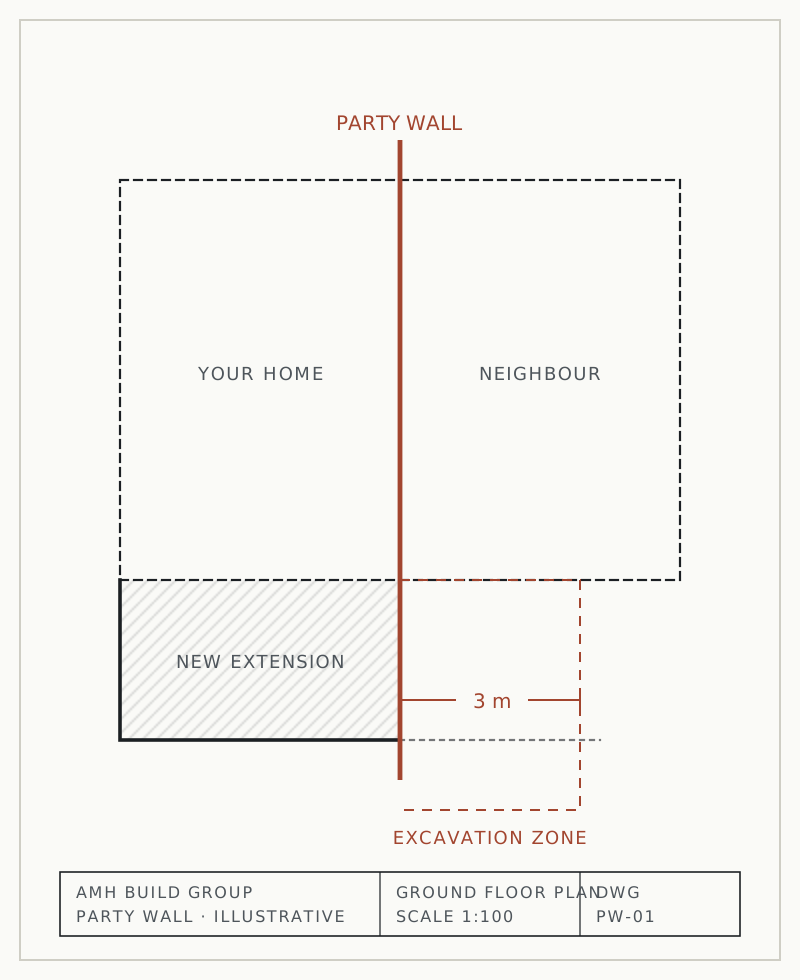
What the Act covers
When you need to serve notice.
The Party Wall etc. Act 1996 applies in England and Wales. It gives you the right to carry out certain work to a shared wall or near a neighbour's foundations — provided you tell them first and protect their property. The three most common notices are:
| Notice | When it applies | Minimum notice |
|---|---|---|
| Party structure notice | Work to a shared wall — for example cutting in a steel beam or a loft conversion | 2 months |
| Line of junction notice | Building a new wall on or up to the boundary line | 1 month |
| Adjacent excavation notice | Digging foundations within 3 m (or in some cases 6 m) of a neighbour's building | 1 month |
Your neighbour has 14 days to respond. If they agree, work can proceed. If they dissent — or don't reply — a party wall surveyor (or one for each side) prepares an award setting out how the work will be done. Notices are valid for a year.
Summary for guidance only. See the government's party wall guidance.
How we help
From first notice to final award.
- 01
Assess
We identify which notices your design needs as soon as the drawings take shape.
- 02
Serve notices
We prepare the notices and plans and serve them on every adjoining owner.
- 03
Talk to neighbours
We explain the work face to face — most agreements are reached without a dispute.
- 04
Surveyors & awards
Where needed, we coordinate with the party wall surveyors and a schedule of condition.
- 05
Build with care
Work follows the award, and we keep neighbours informed throughout.
FAQs
Questions we're often asked
Does every extension need a party wall agreement?
No. You need to serve notice only if your work falls within the Act — typically work to a shared wall, building on the boundary, or excavating close to a neighbour's foundations. Many rear extensions on semis and terraces do.
Who pays the surveyors' fees?
Normally the person carrying out the work (the building owner) pays the reasonable costs of both surveyors.
What if my neighbour says no?
They can't stop work the Act permits, but they can dissent, which means a surveyor-led award decides how the work is done. Explaining the work early and clearly avoids most disputes.
How long does it add to a project?
Plan for at least two months for party structure notices. We serve notices early in the design stage so they rarely delay the start on site.
Start your project
Tell us what you're planning.
A free, no-obligation site visit — an honest view on feasibility, budget and timing before anything is drawn.